Phone: 030 / 40 58 51 00 030 / 40 58 51 00

Monday – Friday 07:30 – 20:00
07:30 – 20:00
2020-04-01
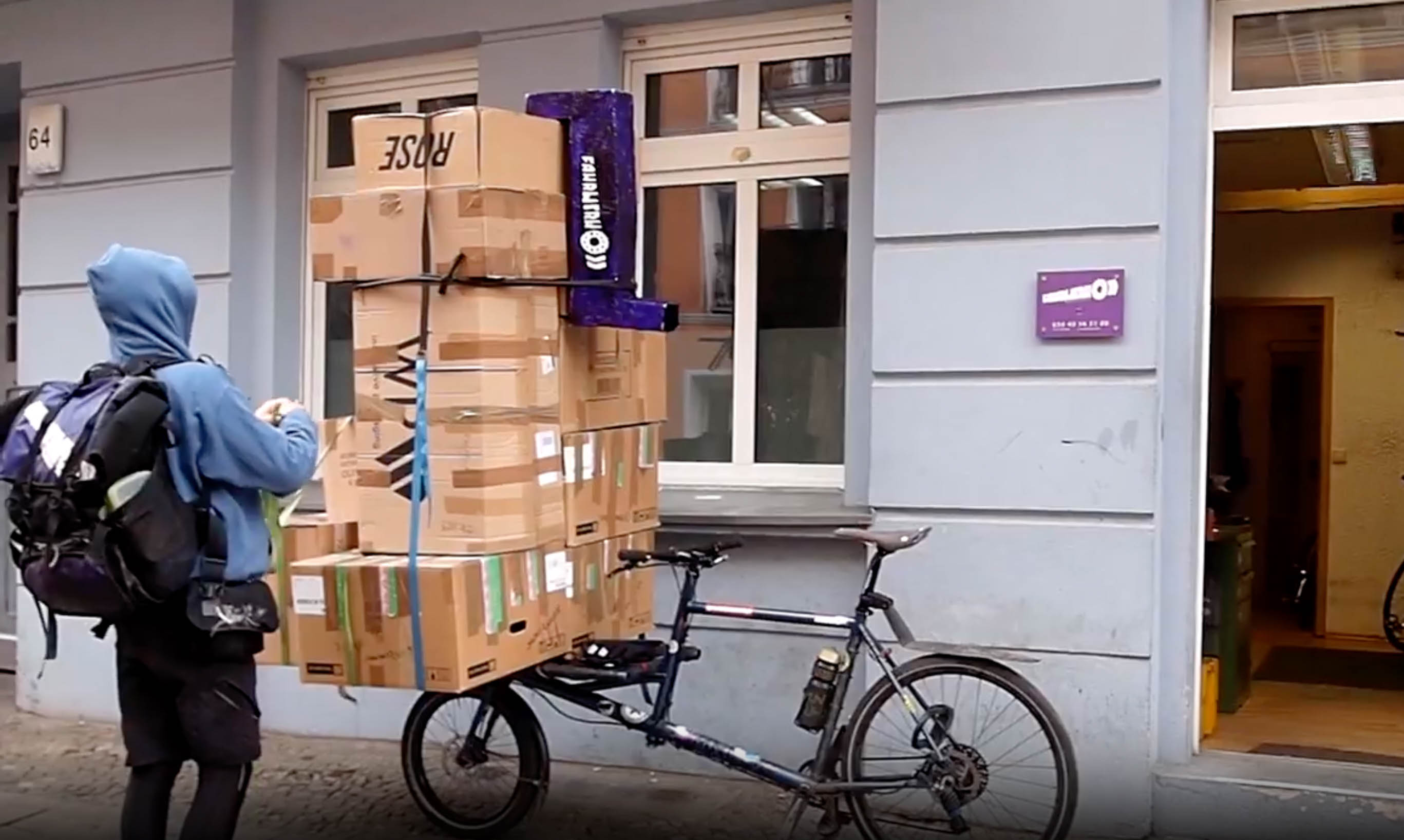
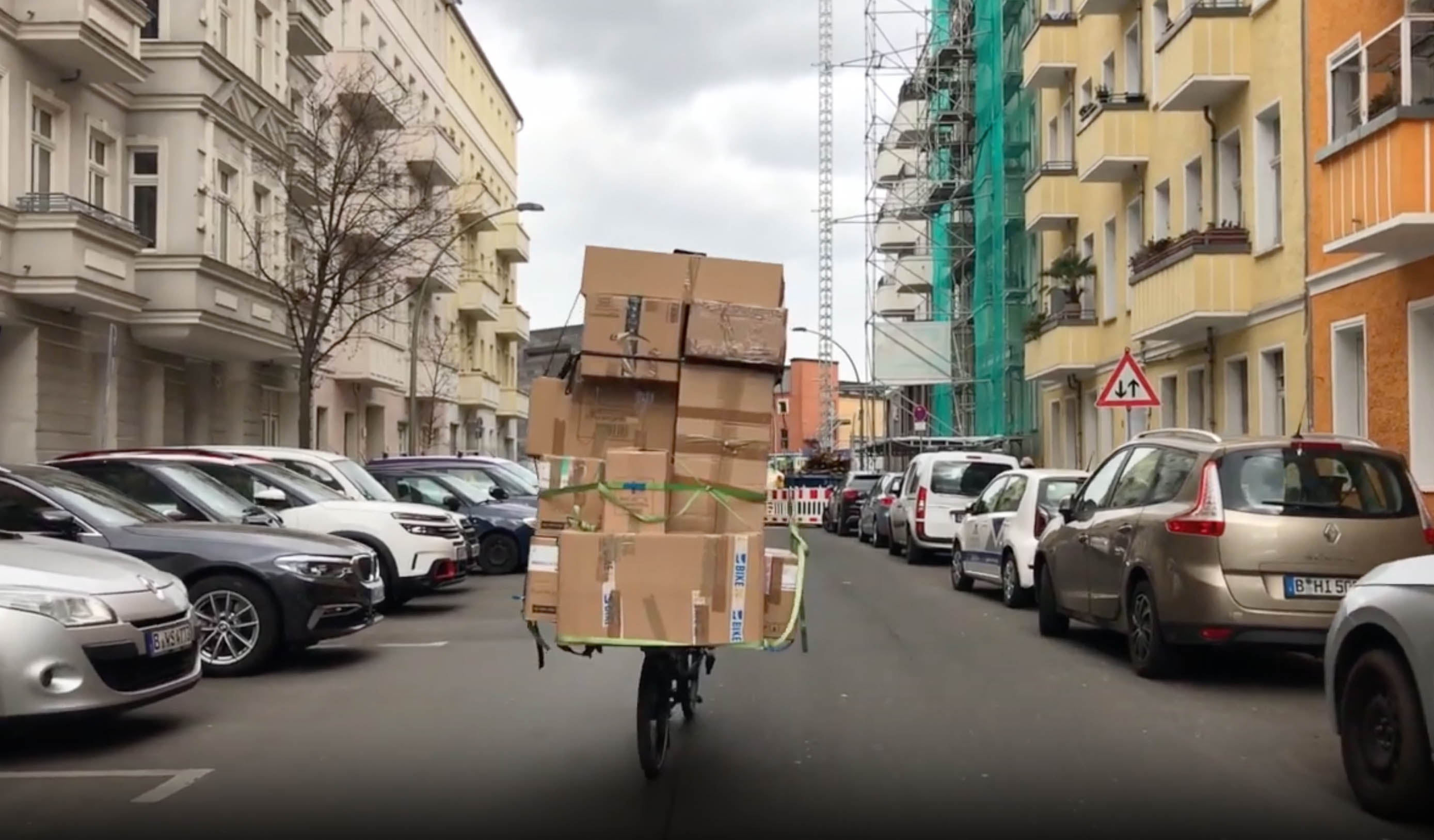
The Cargo Periscope is born from a need to not only win the ‘Carry Shit Olympics’ on a daily basis but to be able to see whilst doing so.
It’s designed to fit any cargo bike, made with Omniums and Bullitts in mind. It’s been road-tested by real bike messengers, throughout the winter on the streets of Berlin. Hardy and durable, it’s made to work as quickly as you do: simply load up your cargo bike, stack it up, secure with elastic, and ride. Compatible with a front box. Now in purple.We’re proud to share some more shots of our new product in action.
We’re releasing it to the world soon. Made of cardboard. Mirrors not included.
Fahrwerk Kurier*innenkollektiv GmbH
Am Treptower Park 17,
12435 Berlin
Amtsgericht Charlottenburg HRB 126538 B
Tax number: 3728230210
Sales tax number: DE271329648
Our service is primarily aimed at business owners.
Legal represents
Made with Kirby CMS.
Code und Gestaltung von laura#31 mit bester Unterstützung von Florian Schimanski.
last update: Sep-2026
Here you can read and download our Terms and Conditions.
last update: Sep 2026
I. Name and Address of the Data Controllers
The controller within the meaning of the General Data Protection Regulation and other national data protection laws, as well as other data protection regulations, is:
Fahrwerk Kurierkollektiv GmbH
Am Treptower Park 17
12435 Berlin
Fon: 030 40 58 51 0 0
Fax: 030 40 58 51 0 10
Mail: datenschutz@fahrwerk-berlin.de
Webseite: fahrwerk-berlin.de
II. General Information on Data Processing
1. Scope of the Processing of Personal Data When you use these pages, personal data is processed only to the extent necessary for the pages to function properly. As a general rule, personal data of users is processed only with their consent. An exception applies in cases where obtaining prior consent is not possible for practical reasons and the processing of the data is permitted by law (creation of log files when using the website).
2. Legal Basis for the Processing of Personal Data Personal data is not collected without the users’ express consent. To the extent that processing takes place, Article 6(1)(a) of the EU General Data Protection Regulation (GDPR) serves as the legal basis.
3. Data Deletion and Retention Period The data subject’s personal data will be deleted or blocked as soon as the purpose for which it was stored no longer applies. Data may also be stored if this is provided for by European or national legislation in EU regulations, laws, or other provisions to which the data controllers are subject. Data will also be blocked or deleted when a retention period prescribed by the aforementioned standards expires, unless further storage of the data is necessary for the performance of a contract.
III. Provision of the Website and Creation of Log Files
1. Description and Scope of Data Processing Every time our website is accessed, our system automatically collects data and information from the computer system of the accessing device.The following data from the accessing device is collected:– Information about the browser type and version used– The operating system– The Internet service provider– The IP address– Date and time of access– Websites from which the system accesses our website– Websites accessed by the system via our websiteThe log files contain IP addresses or other data that allow for the identification of a user. This could be the case, for example, if the link to the website from which the user accesses our website, or the link to the website to which the user navigates, contains personal data.The data is also stored in our system’s log files. This data is not stored together with any other personal data belonging to the user.
2. Legal Basis for Data Processing The legal basis for the temporary storage of data and log files is Article 6(1)(f) of the GDPR. The legitimate interest lies in optimizing the website and ensuring the security of our information technology systems.
3. Purpose of Data Processing The system must temporarily store the IP address to enable the website to be delivered to the user’s computer. To do this, the user’s IP address must be stored for the duration of the session. The data is stored in log files to ensure the website functions properly. In addition, we use the data to optimize the website and to ensure the security of our IT systems. The data is not analyzed for marketing purposes in this context.
4. Duration of Storage The data will be deleted as soon as it is no longer necessary to achieve the purpose for which it was collected. In the case of data collected to provide the website, this occurs when the respective session ends. In the case of data stored in log files, this occurs after seven days at the latest. If you contact us via the contact form, your personal data will be deleted immediately after your inquiry has been processed.
5. Right to Object and Remedy The collection of data for the purpose of providing the website and the storage of that data in log files is absolutely necessary for the operation of the website. Consequently, users have no option to object.
6. Access to, Modification, and Deletion of Your Data In accordance with applicable law, you may contact us in writing at any time to inquire whether we have stored any personal data about you and, if so, what data we have stored. You will receive a response to this inquiry promptly, in accordance with Article 15(1) of the GDPR.
7. Data Security The personal data you provide to us is secured through the implementation of all technical and organizational security measures to ensure that it remains inaccessible to unauthorized third parties.
8. Cookies
IV. Rights of the Data Subject
If your personal data is processed, you are a data subject as defined by the GDPR, and you have the following rights with respect to the data controllers:
1. Right to Information You may request confirmation from the data controller as to whether we are processing personal data concerning you. If such processing is taking place, you may request the following information from the data controller:
– the purposes for which the personal data is being processed;
– the categories of personal data being processed;
– the recipients or categories of recipients to whom the personal data concerning you has been or will be disclosed;
– the planned duration of storage of the personal data concerning you or, if specific details cannot be provided, the criteria used to determine the storage period;
– the existence of a right to rectification or erasure of personal data concerning you, a right to restrict processing by the controller, or a right to object to such processing;
– the existence of a right to lodge a complaint with a supervisory authority;
– all available information regarding the origin of the data, if the personal data is not collected from the data subject;
– the existence of automated decision-making, including profiling, pursuant to Article 22(1) and (4) of the GDPR and
—at least in these cases—meaningful information regarding the logic involved, as well as the scope and intended effects of such processing on the data subject.You have the right to request information regarding whether the personal data concerning you will be transferred to a third country or to an international organization. In this context, you may request to be informed of the appropriate safeguards pursuant to Article 46 of the GDPR in connection with the transfer.
This right of access may be restricted to the extent that it is likely to render impossible or seriously impair the achievement of research or statistical purposes, and the restriction is necessary for the fulfillment of those research or statistical purposes.
2. Right to Rectification You have the right to request that the data controllers correct and/or complete your personal data if the processed personal data concerning you is inaccurate or incomplete. The data controllers must make the correction without delay.
3. Right to Restriction of Processing Under the following conditions, you may request the restriction of the processing of your personal data:
– if you contest the accuracy of your personal data for a period that allows the controller to verify the accuracy of the personal data;
– if the processing is unlawful and you oppose the erasure of the personal data and instead request the restriction of its use;
– the controller no longer needs the personal data for the purposes of processing, but you need it to assert, exercise, or defend legal claims; or
– if you have objected to the processing pursuant to Article 21(1) of the GDPR and it has not yet been determined whether the controller’s legitimate grounds override your interests.
f the processing of your personal data has been restricted, such data—with the exception of its storage—may be processed only with your consent, or for the purpose of asserting, exercising, or defending legal claims, or to protect the rights of another natural or legal person, or for reasons of an important public interest of the Union or a Member State.
If the restriction on processing has been imposed in accordance with the above conditions, the controller will notify you before the restriction is lifted.
4. Right to Erasure a) Obligation to Erase Data
You may request that the data controllers immediately erase the personal data concerning you if any of the following grounds apply:
– The personal data concerning you is no longer necessary for the purposes for which it was collected or otherwise processed. You withdraw your consent on which the processing was based pursuant to Article 6(1)(a) or Article 9(2)(a) of the GDPR, and there is no other legal basis for the processing.
– You object to the processing pursuant to Article 21(1) of the GDPR and there are no overriding legitimate grounds for the processing, or you object to the processing pursuant to Article 21(2) of the GDPR.
– The personal data concerning you has been processed unlawfully.
– The erasure of the personal data concerning you is necessary to comply with a legal obligation under Union law or the law of the Member States to which the controller is subject.
– The personal data concerning you was collected in connection with information society services offered pursuant to Article 8(1) of the GDPR.
b) Notification to Third Parties
If the controllers have made the personal data concerning you public and are required to erase it pursuant to Article 17(1) of the GDPR, they shall take appropriate measures, including technical measures, taking into account the available technology and the cost of implementation, to inform the controllers who process the personal data that you, as the data subject, have requested the erasure of all links to such personal data or of copies or replicas of such personal data.
c) Exceptions
The right to erasure does not apply to the extent that the processing is necessary
(1) to exercise the right to freedom of expression and information;
(2) to comply with a legal obligation that requires processing under Union or Member State law to which the controller is subject, or to perform a task carried out in the public interest or in the exercise of official authority vested in the controller;
(3) for reasons of public interest in the area of public health pursuant to Article 9(2)(h) and (i) and Article 9(3) of the GDPR;
(4) for archiving purposes in the public interest, scientific or historical research purposes, or for statistical purposes pursuant to Article 89(1) of the GDPR, to the extent that the right referred to in subsection (a) is likely to render impossible or seriously impair the achievement of the objectives of such processing; or
(5) for the establishment, exercise, or defense of legal claims.
5. Right to Information If you have exercised your right to rectification, erasure, or restriction of processing with the data controllers, they are obligated to notify all recipients to whom your personal data has been disclosed of such rectification, erasure, or restriction of processing, unless this proves impossible or involves disproportionate effort. You have the right to request information from the data controllers regarding these recipients.
6. Right to Data Portability You have the right to receive the personal data concerning you that you have provided to the controller in a structured, commonly used, and machine-readable format. You also have the right to transmit this data to another controller without hindrance from the controller to whom the personal data was provided, provided that
(1) the processing is based on consent pursuant to Article 6(1)(a) of the GDPR or Article 9(2)(a) of the GDPR, or on a contract pursuant to Article 6(1)(b) of the GDPR, and(2) the processing is carried out by automated means.In exercising this right, you also have the right to have the personal data concerning you transmitted directly from one controller to another, to the extent that this is technically feasible. The freedoms and rights of other individuals must not be infringed upon as a result.The right to data portability does not apply to the processing of personal data that is necessary for the performance of a task carried out in the public interest or in the exercise of official authority vested in the controller.
7. Right to Object You have the right to object at any time, on grounds relating to your particular situation, to the processing of personal data concerning you that is carried out pursuant to Article 6(1)(e) or (f) of the GDPR; this also applies to profiling based on these provisions.
The controller will no longer process the personal data concerning you unless it can demonstrate compelling legitimate grounds for the processing that override your interests, rights, and freedoms, or the processing is necessary for the establishment, exercise, or defense of legal claims.
If the personal data concerning you is processed for the purpose of direct marketing, you have the right to object at any time to the processing of the personal data concerning you for the purpose of such marketing; this also applies to profiling to the extent that it is related to such direct marketing.
If you object to processing for direct marketing purposes, the personal data concerning you will no longer be processed for these purposes.
In connection with the use of information society services—notwithstanding Directive 2002/58/EC—you have the option to exercise your right to object using automated procedures that employ technical specifications.
8. Right to Withdraw Consent Under Data Protection Law You have the right to withdraw your consent under data protection law at any time. Withdrawing your consent does not affect the lawfulness of the processing carried out on the basis of your consent prior to its withdrawal.
9. Automated decision-making in individual cases, including profiling You have the right not to be subject to a decision based solely on automated processing—including profiling—that produces legal effects concerning you or similarly significantly affects you. This does not apply if the decision
(1) is necessary for the conclusion or performance of a contract between you and the controller,
(2) is authorized by Union or Member State law to which the controller is subject, and such law provides for appropriate measures to safeguard your rights and freedoms as well as your legitimate interests, or
(3) is based on your explicit consent.
However, these decisions may not be based on special categories of personal data as defined in Article 9(1) of the GDPR, unless Article 9(2)(a) or (g) of the GDPR applies and appropriate measures have been taken to protect your rights and freedoms as well as your legitimate interests.
With regard to the cases referred to in (1) and (3), the controllers shall take appropriate measures to safeguard your rights and freedoms as well as your legitimate interests, including, at a minimum, the right to request human intervention by the controller, to state your point of view, and to contest the decision.
10. Right to File a Complaint with a Supervisory Authority Without prejudice to any other administrative or judicial remedy, you have the right to lodge a complaint with a supervisory authority—in particular, in the Member State of your residence, your workplace, or the location of the alleged infringement—if you believe that the processing of your personal data violates the GDPR.The supervisory authority to which the complaint was submitted shall inform the complainant of the status and outcome of the complaint, including the possibility of a judicial remedy under Article 78 of the GDPR.